This story of the civilization of San Diego and California
can all be told by the history of the grapevine and where
it rooted in California. You will find some of this story
reflected
in our wine list and our menu that takes directions from
the traditional regional food of this eclectic land that
we know
as California.
The history of wine in San Diego County commences with
the establishment of the Missions under the Flag of Spain
where
the first wine grapes were planted in California – San
Diego, in fact. After the Missions were secularized, vineyards
continued to be tended in the romantic days of the Silver
Dons on their Ranchos.
Many of the immigrants that flooded the hills of Julian
and the valley of Escondido seeking gold and silver discovered
they could create liquid gold, “wine” and remained
in the area. At one time, over 10,000 acres of the County was
planted in vineyards – the largest vineyards existing
in El Cajon and Escondido.
After Prohibition, North San Diego County, alone, had over
35 wineries. Two of those family operated wineries, both
established in the late 1800’s, still exist today run
by another generation, the Ferrar Winery in Escondido and
the Bernardo
Winery in Rancho Bernardo.
Our goal at Friars Folly Wine Cellar is to celebrate, with
wine and food, the agricultural and wine-making legacy of
the Franciscan Padres and the rich heritage of the land we
now live on. Friars Folly Wine Cellar is a tribute to the
efforts of the educated Padres and Californios who forever
changed the landscape of California and established one of
the world’s most recognized wine producing regions.
The story of San Diego and California can all be told by
the history of the grapevine and why it rooted where it
did in California. You will find some of this story reflected
in our wine list and our menu that takes directions from
the traditional regional food of this eclectic land that
we know as California.
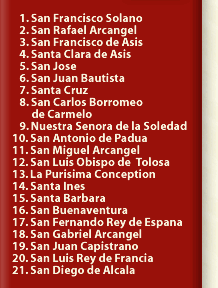
WINE & THE MISSIONS In 1759, Padre Serra established Mission San Diego, the first
of a chain of __ missions that became connected by a path known
as El Camino Real, (“the King’s Road”). Once
traveled on by sandaled Friars, Spanish and American soldiers,
and explorers and adventurers like Kit Carson, Hungarian Count
Agoston Haraszathy (known as the first sheriff of San Diego
and “Father of the Modern Wine-Making Industry) and Wyatt
Earp – it is the same road you drive on today, except
it’s covered with asphalt and expanded to many lanes.
Each mission was strategically located to be one day’s
journey apart and its white washed presence was a symbol of
hospitality to the early travelers of California. The Friars
boarded these travelers and rejuvenated them with food, wine,
rest and a fresh horse for the next part of their journey.
Like those early travelers’ who heard the Mission bells
ring and set sight on the tower almost 250 years ago, you too
will know that a welcoming hospitality awaits you when you
see the Mission bell tower above Friars Folly Wine Cellar in
Old California Restaurant Row.
The history of wine in San Diego County commences with
the establishment of the Missions under the Flag of Spain
where
the first wine grapes were planted in California.
The Friars introduced so much of what makes California
so special - the Mediterranean foods – wine, olives, citrus, pomegranates,
tomatoes, chilies, tortillas, grains, fruits and beautiful
vegetables; wine, Spanish architecture, and a spirit of hope
and opportunity.
San Diego County is home to two of California’s Missions
and tow Astentencias – the first mission in the chain,
Mission San Diego de Alcala, the “Mother Mission” and
Mission San Luis Rey, the “Queen of the Missions” and
it’s "asistencia" mission the San Antonio de
Pala, and the "asistencia" Santa Margerita.
WINE & THE RANCHOS
After the Missions were secularized, vineyards continued
to be tended in the romantic days of the Silver Dons on their
Ranchos. Become one with the past, and imagine two week long
fiestas filled with exciting rodeos in the spring when thousands
of cattle were rounded up and branded in spring at the Ranchos
- Rancho Los Felicitas (known now as San Marcos), Rancho
San Digeuito (later to become know as Rancho Santa Fe when
the railroad purchased it), Rancho San Bernardo and Rancho
Rincon del Diablo (Escondido).
Dream of a place in time where beautiful senoritas traveling
in horse drawn carretas from Old Town San Diego to watch
the brave young cabbaleros exhibit their horsemanship, drink
wines made from the grapes of the Rancho’s vineyards,
and later dance the fandango.
Wine & Immigrants
Many of the immigrants that flooded the hills of Julian
and the valley of Escondido seeking gold and silver remained
and discovered they could create liquid gold, “wine” and
remained in the area. At one time, over 10,000 acres of the
County was planted in vineyards – the largest vineyards
existing in El Cajon and Escondido. After Prohibition, North
San Diego County, alone, had over 35 wineries. Two of those
family operated wineries, both established in the late 1800’s,
still exist today run by another generation, the Ferrar Winery
in Escondido and the Bernardo Winery in Rancho Bernardo.
|